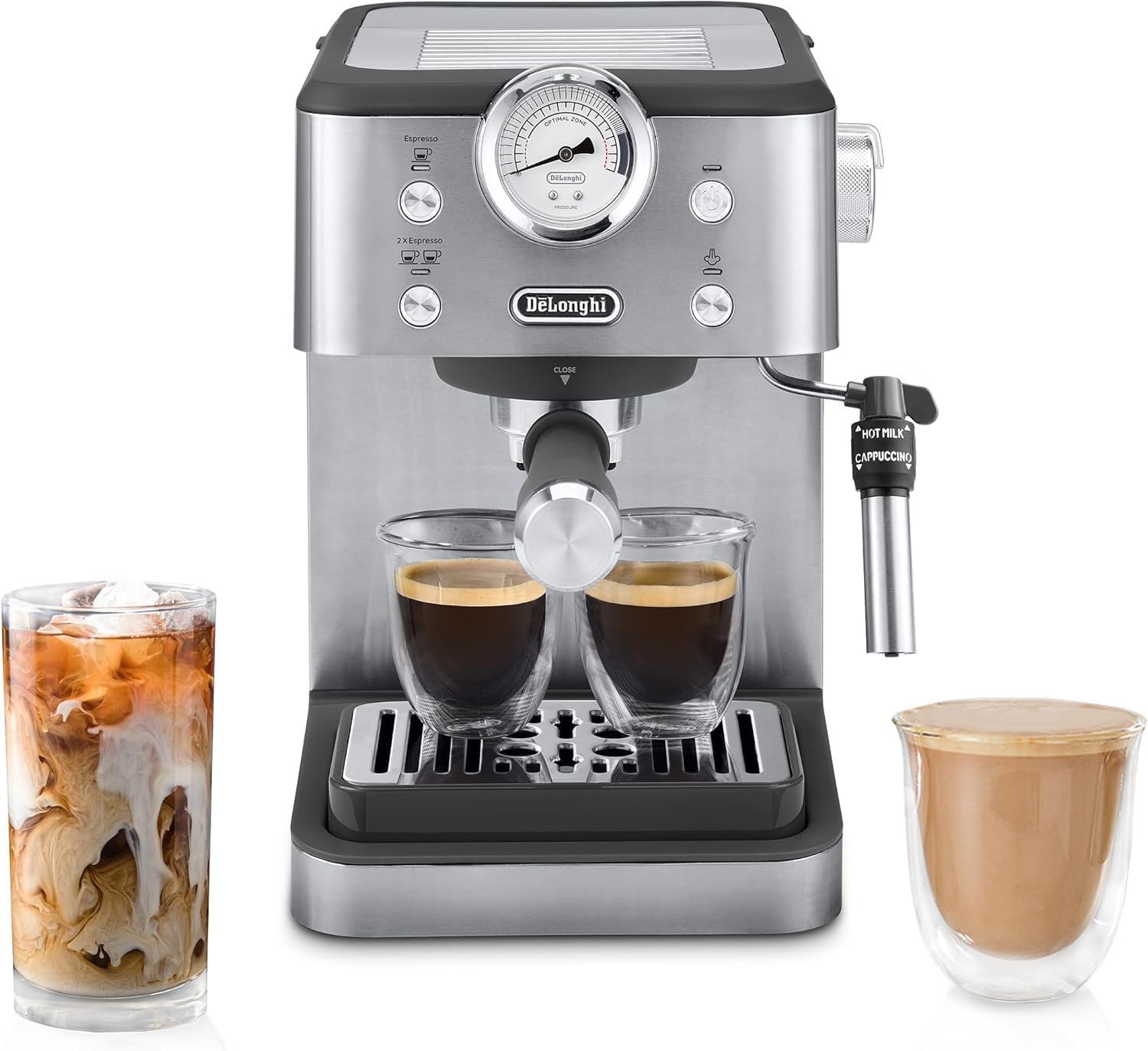


Breville Barista Express Impress (BES876)
Top PickBest Espresso QualityBest for BeginnersThe most beginner-proof way to pull cafe-quality espresso at home.
Our Rating
9.3$1,149.99
Check Price Specifications
| Brand | Breville |
|---|---|
| Machine Type | Semi-Automatic (portafilter) |
| Built-in Grinder | Yes - conical burr, 25 settings |
| Milk System | Manual microfoam steam wand |
| Portafilter | 54mm stainless steel |
| Heating System | ThermoCoil with PID |
| Dosing/Tamping | Intelligent auto-dosing + assisted tamping (10kg, 7 twist) |
| Water Tank | 2 L |
| Bean Hopper | 250 g |
| Power | 1600 W |
| Warranty | 2-year limited |
| Country of Origin | China |
Pros
- Impress puck system with assisted tamping (7 barista twist, consistent 10 kg) removes the #1 beginner mistake
- Intelligent Dosing auto-measures and auto-corrects the next dose for repeatable shots
- PID (ThermoCoil) temperature control and low-pressure pre-infusion for even, balanced extraction
- Integrated 25-setting conical burr grinder - beans to espresso in one machine
- Powerful manual microfoam steam wand for genuine latte art
- Full stainless-steel body and Breville's proven service network in Canada
Cons
- Now $1,149.99 - a ~$250 jump versus earlier pricing erodes its value edge over the standard Barista Express
- Built-in conical grinder is a known long-term failure point across the Barista series
- Large footprint needs real counter space
- Manual milk texturing still has a learning curve
- Single boiler means a brief wait between steaming and pulling
Rating Breakdown
Espresso Quality & Extraction 9.5
Milk Frothing & Steam Power 9.1
Build Quality & Durability 9.4
Ease of Use & Convenience 9.3
Value for Money 8.8
Our Verdict
This is the easiest path to consistent, cafe-quality shots from a real portafilter machine: assisted tamping and Intelligent Dosing take over the two steps beginners get wrong, while PID temperature control and pre-infusion do the rest. It posts the highest espresso score in the field - the only real knock is the climb to $1,149.99, which narrows its lead over the cheaper Barista Express to a matter of convenience.


